The Hidden Tax: 7 Surprising Things That Are Difficult (or Impossible) with Bad Credit

Ashley Rivera
Credit Repair Specialist

You found the apartment. The kitchen had the natural light you wanted, the rent fit your budget, and the location was perfect. You filled out the application, paid the $50 fee, and started mentally arranging the furniture. Two days later, the email landed: "Unfortunately, we're unable to approve your application at this time." No real explanation. Just a polite door slammed in your face.
If you've lived through a moment like that, you already know what most personal finance articles dance around: bad credit doesn't just affect your ability to get a loan. It quietly follows you everywhere. It shows up at the cell phone counter, the insurance quote, the utility hookup, even the job interview. It charges you more for the same products your neighbor gets at a discount. It denies you opportunities you didn't even know required a credit check.
Think of it as a hidden tax. You pay it in higher deposits, inflated premiums, missed rewards, and doors that simply don't open. The frustrating part? Most people don't realize how wide the damage spreads until they bump into it.
Here are seven surprising places where bad credit costs you — and what you can actually do to stop paying that tax.
- Renting an apartment or house
- Getting a cell phone plan
- Setting up basic utilities
- Landing certain jobs
- Buying auto and home insurance
- Accessing premium financial products
- Starting your own business
1. Renting an Apartment (or House)
Landlords aren't banks, but they think like them. When you apply for a rental, almost every property manager runs a credit check before handing over the keys. They're not just looking at your score either. They're scanning for collections, late payments, prior evictions, and how much debt you're already carrying.
A low score usually drops you into one of three frustrating buckets:
- Flat-out denial. Many large property management companies use a hard cutoff (often around 620). Below it, the answer is automatic, no matter how strong your income looks.
- A bigger security deposit. Some landlords will approve you but want two or three months of rent up front to offset the perceived risk. On a $1,500 apartment, that's an extra $3,000 to $4,500 out of pocket before you've moved a single box.
- A required cosigner. If you can't qualify alone, you may have to ask a parent, sibling, or friend to put their name (and credit) on the line. That's an awkward conversation no adult wants to have.
Even private landlords who skip the formal credit pull will often ask for tax returns, paystubs, or extra deposits when they sense risk. Bad credit makes the rental market a smaller, more expensive place. We've covered this in more depth in our guide on what credit score you need to rent an apartment.
2. Getting a Cell Phone Plan
Walking into a Verizon, AT&T, or T-Mobile store should feel routine. For most people, it is. They pick a phone, pick a plan, and walk out. For someone with bad credit, that same trip can end at the register.
The big carriers run a credit check the moment you try to start a postpaid line. If your score is low, you'll typically run into one of these outcomes:
- A deposit per line. Carriers commonly require deposits ranging from $200 to $700+ per line for customers with weak credit. A family of four trying to start service together could be staring down a $2,000+ bill before they ever make a call.
- A financing denial on the device. That "free" iPhone deal you saw on TV? It's actually a 36-month installment plan that requires a credit approval. Bad credit means you pay full price up front or walk away.
- Forced into prepaid. You can still get service through a prepaid carrier, but you usually lose the better promos, the device financing, and the family plan discounts. You end up paying more for less.
It's a strange feeling to be told you can't have a phone plan. But for thousands of Americans every day, that's exactly what happens.
3. Setting Up Utilities
Here's one almost nobody warns you about. When you call to turn on the electricity, gas, water, or internet at a new place, that utility company often runs a credit check too. They're trying to predict whether you'll pay the bill.
If your credit is bad, expect:
- A security deposit of $100 to $400+ per service. Stack electric, gas, and internet together and you can easily be $600 to $1,200 deep just to flip the lights on.
- A required cosigner or letter of guarantee. Some companies will only waive the deposit if someone with good credit vouches for you.
- Delayed service. If you can't pay the deposit immediately, you might be moving into a dark, cold apartment for a few days while you sort it out.
Moving is already expensive. Bad credit pours gasoline on that fire at the exact worst moment.
4. Landing Certain Jobs
This one catches people off guard. You can absolutely lose out on a job because of your credit report.
It's not legal in every state, and not every employer does it, but plenty do — especially for roles in:
- Banking, lending, and financial services
- Government and federal contracting (security clearance roles)
- Accounting, payroll, and bookkeeping
- Executive and management positions
- Any role that handles cash, customer payment data, or company finances
Employers don't see your actual FICO score, but they can see your full credit report: collections, judgments, bankruptcies, charge-offs, late payments. To a hiring manager, that history can read as "this person can't manage money" — which becomes a red flag for jobs that involve managing other people's money.
You can be the most qualified candidate in the room and still get passed over because of something that happened on a credit card seven years ago. We dig into this further in our piece on whether employers can check your credit.
5. Paying More for Auto and Home Insurance
This is one of the most expensive hidden taxes on the list, and most people have no idea it's happening to them.
Auto and home insurance companies in most states use something called a credit-based insurance score to help set your premium. They've decided, based on years of internal data, that people with lower credit scores tend to file more claims. Whether or not that's fair is a debate for another day. What matters is that they price for it.
The numbers are real. Drivers with poor credit can pay 50% to 130% more for the exact same auto policy as drivers with excellent credit, even with a clean driving record. Same car. Same address. Same coverage. Just a different score.
Stretch that out over a decade and you're looking at thousands — sometimes tens of thousands — of dollars paid in extra premiums for the privilege of having a low credit score. Our guide on how credit score affects insurance rates breaks this down further.
6. Accessing Premium Financial Products
Most people focus on getting any credit card or loan when they have bad credit. But the bigger long-term cost isn't being denied — it's getting stuck with the worst version of every product on the market.
With a low score, you're locked out of:
- Cashback and rewards cards. The 2% back on groceries, the 5% on gas, the airline miles — those exist for people with good credit. Your only option is usually a high-fee, no-rewards starter card.
- 0% APR intro offers. Need to finance a fridge or pay down a balance? Good credit gets you 12 to 21 months interest-free. Bad credit gets you 24%+ APR from day one.
- Low-interest auto loans. The same car at the same dealership can cost you $5,000 to $15,000 more over the life of the loan if you're financing at 18% instead of 6%.
- Personal loans with reasonable rates. A $10,000 debt consolidation loan at 9% looks completely different than the same loan at 32%.
The cost of bad credit isn't just the doors that close. It's the doors that open into much more expensive rooms. We've laid out the math in detail in our breakdown of the #1 factor killing your credit score.
7. Starting Your Own Business
If you've ever dreamed of opening a shop, launching a service business, or going full-time on a side hustle, your personal credit will follow you into that journey whether you like it or not.
Here's why: most banks and lenders look at the owner's personal credit before they'll approve any business funding — especially in the first two years, before the business has its own credit profile. That means:
- SBA loans become a long shot. Most SBA lenders want to see personal scores of 680+ before they'll seriously consider an application.
- Business credit cards are out of reach. Cards from Chase Ink, Amex Business, and Capital One Spark all pull personal credit. A low score means automatic denial.
- Commercial leases get harder. Landlords leasing to a brand-new business almost always run the owner's personal credit. Same problem as renting an apartment, just with bigger numbers attached.
- You end up bootstrapping with high-cost capital. Merchant cash advances, factoring, and short-term online lenders will take you — at effective interest rates of 40% to 100%+. That kind of debt has buried plenty of promising businesses before they ever got off the ground.
Want a deeper dive? See our guide on how to build business credit with bad personal credit.
Breaking Free from the Hidden Tax
The good news: a low credit score isn't a permanent sentence. Credit reports are dynamic. They change every month based on what's reported and what's challenged. Items that shouldn't be there — and there are usually more of those than people realize — can come off. Accounts can be rebuilt. Scores can move.
The basic playbook looks like this:
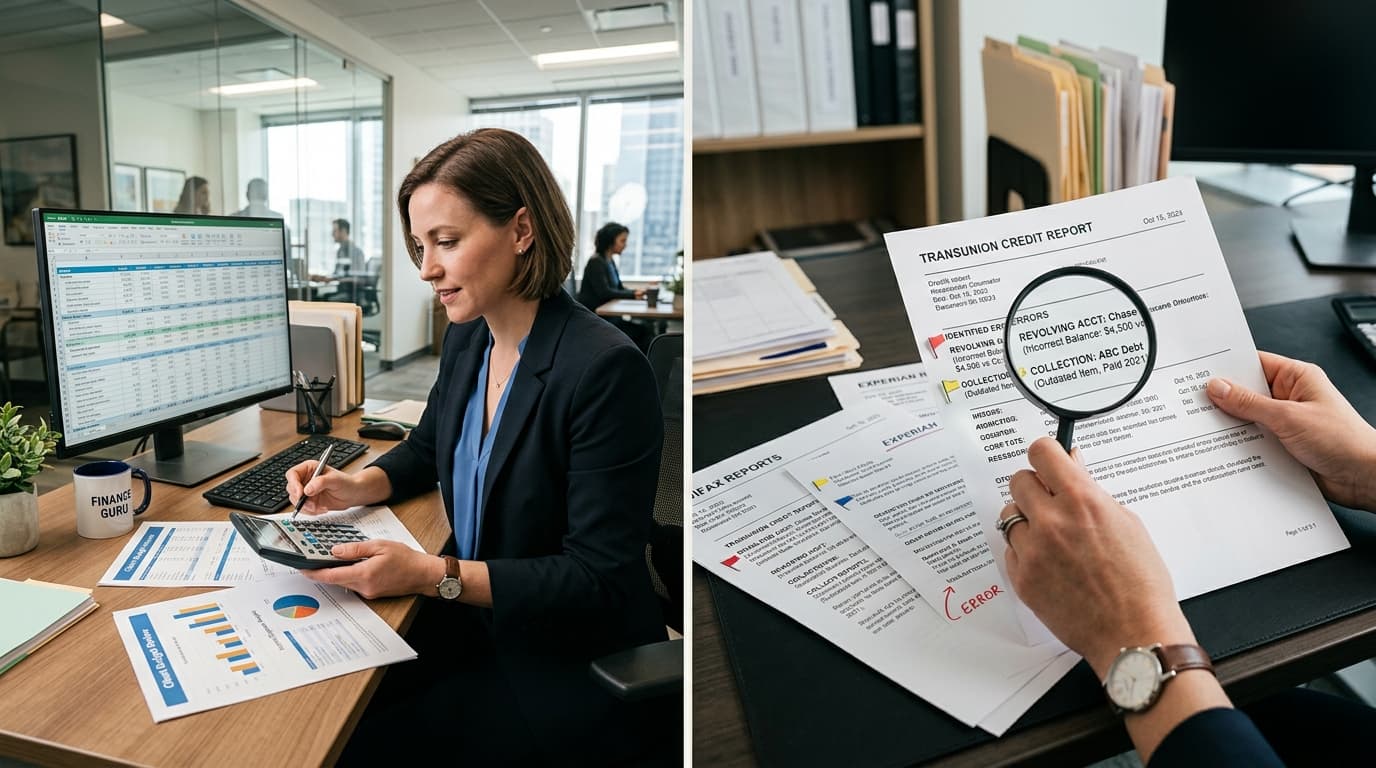
- Pull all three reports from Equifax, Experian, and TransUnion. They don't always say the same thing.
- Identify every negative item — collections, charge-offs, late payments, hard inquiries, public records — and check each one for accuracy, completeness, and proper verification.
- Challenge questionable items with the bureaus and the original creditors. Under the FCRA, anything reported about you must be accurate, complete, and verifiable. If a furnisher can't back it up, it has to come off.
- Build positive credit in parallel. A secured card, a credit-builder loan, or being added as an authorized user on a strong account can all help while the cleanup happens.
- Keep utilization low and pay every account on time, every month. The basics still matter.
You can absolutely do all of this yourself. Plenty of people have. But it's a lot of paperwork, a lot of follow-up, a lot of letters back and forth, and a lot of knowing exactly which laws to invoke and when. That's where we come in.
At Crowned Credit, this is what we do every day. We pull the reports, identify the items worth challenging, and use your rights under the FCRA to push the bureaus and creditors to verify everything they're reporting on you. When they can't, items come off. We pair that with personalized credit-building guidance so the score has somewhere to go once the noise is cleared. You can see our pricing here — Essential is $150 setup and $99/month, Accelerated is $249 setup and $199/month, and Momentum is a one-time, prepaid plan priced by custom quote for clients who want a faster, more aggressive timeline.
Disclaimer: Results vary and are not guaranteed. Crowned Credit works to ensure the accuracy and verifiability of items on your credit report, which may result in a score increase over time. Timelines depend on the specifics of your individual file.
The Bottom Line
Bad credit isn't just an inconvenience. It's a tax you pay every time you sign a lease, set up a phone, quote a car insurance policy, apply for a job, or try to start something of your own. Most people don't add it up because the costs come in pieces — $400 here, a higher rate there, an opportunity quietly missed somewhere else. But the total is real, and over a lifetime it can run into the tens of thousands of dollars.
You don't have to keep paying it. Reports can be cleaned up. Scores can move. Doors that have been closed for years can open again.
If you're tired of the hidden tax, take the first step. Book a free consultation with our team at Crowned Credit, or call us directly at 336-310-0090. We'll pull your situation apart, show you exactly what's hurting your score, and lay out a clear plan to fix it.