Credit Repair Scams to Avoid in 2026 (And How to Spot Them)

Ashley Rivera
Credit Repair Specialist
The Credit Repair Industry Has a Fraud Problem
Every year, the Federal Trade Commission receives thousands of complaints about credit repair fraud. People in financial distress — already stressed about their credit — get targeted by operators who take their money and deliver nothing, or worse, actively make their situation worse.
The good news: these scams follow predictable patterns. Once you know what to look for, they're easy to spot. This guide covers the 7 most common credit repair scams circulating in 2026, how to identify them, and what legitimate credit restoration services actually look like.
Scam #1: Upfront Payment Demands
This is the most common — and most clear-cut — red flag in the industry.
The Credit Repair Organizations Act (CROA), a federal law, explicitly prohibits credit repair companies from charging you before they've actually performed services. Full stop. If a company asks for payment before doing any work on your file, they are operating illegally.
How the scam works: You pay $300–800 upfront. The company either disappears entirely, sends a few generic letters that accomplish nothing, or runs out of steam after one round. You have little recourse because you've already paid.
What legitimate companies do: Charge monthly after services are rendered, or structure payment around completed milestones. An initial enrollment fee is standard when it covers real, upfront work — like a full credit report analysis, a personalized strategy session, onboarding into a client portal, and building your first round of disputes. The key is that actual work is being performed, not just a payment collected.
At Crowned Credit, your enrollment fee covers a comprehensive credit analysis across all three bureaus, a one-on-one consultation to review your report, full onboarding into our system, and preparation of your initial dispute strategy. You know exactly what's being done and what you're paying for before anything is charged.
Scam #2: Guaranteed Score Increases
Any company that guarantees a specific credit score increase is lying to you — and breaking federal law. Under CROA, making false or misleading statements about credit restoration services is explicitly prohibited.
Your credit score depends on dozens of variables: your payment history, how creditors respond to disputes, how quickly bureaus update their records, your current utilization, and factors outside anyone's control. No company can guarantee outcomes they don't control.
Common versions of this scam:
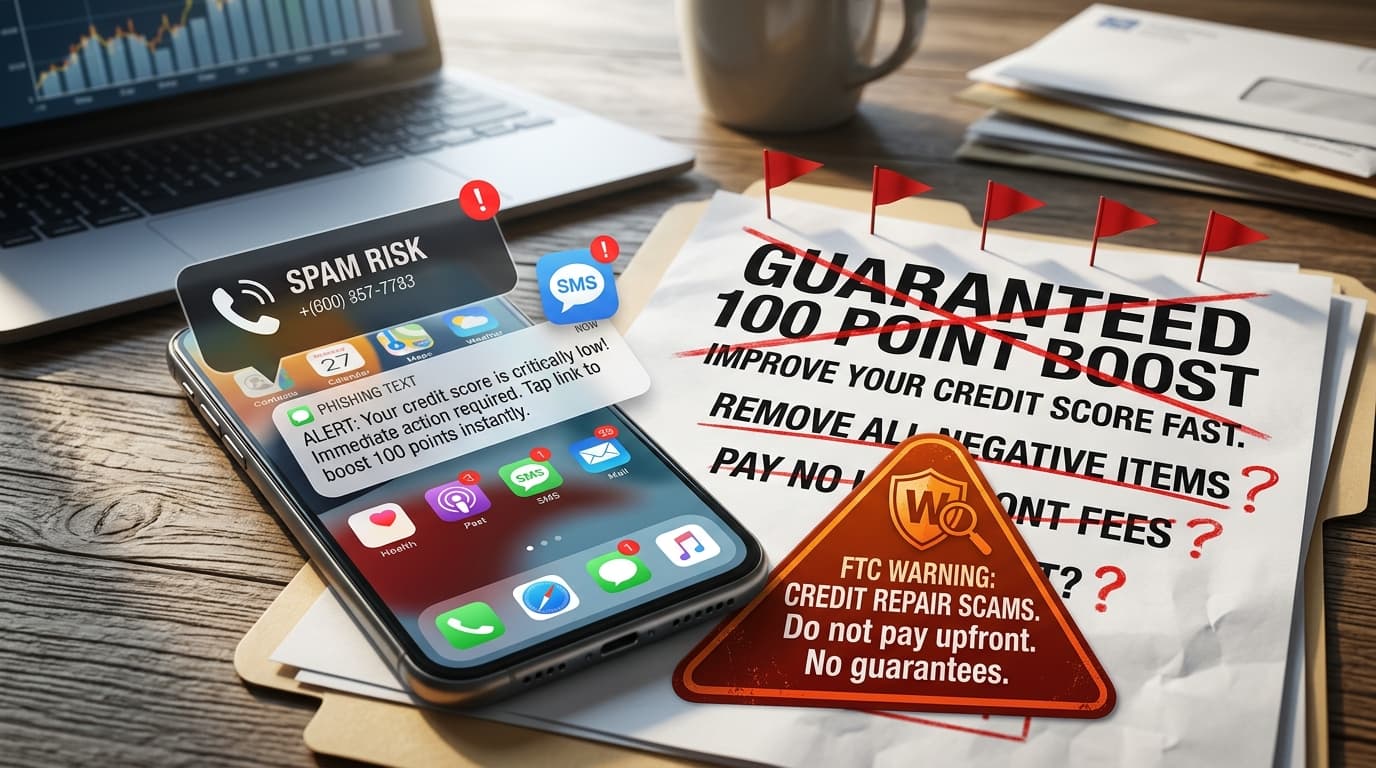
- "We guarantee your score will increase by 100 points in 90 days"
- "We have a 100% deletion success rate"
- "Guaranteed results or your money back" (often with fine print that makes the refund impossible to claim)
What legitimate companies say: They explain the dispute process, describe what they'll do, and give you realistic expectations based on your specific profile — without making promises they can't keep. Results vary based on individual credit profiles and are not guaranteed.
Scam #3: Credit Privacy Number (CPN) Fraud
This one doesn't just cost you money — it can land you in federal prison.
The pitch sounds appealing: "Get a fresh start with a new 9-digit number that replaces your Social Security number for credit purposes." They call it a Credit Privacy Number, a Secondary Credit Number, or a Shelf Corporation Number. It's often marketed to people with severely damaged credit who feel like they have no other options.
Here's the reality: CPNs are fraud. Using a fabricated number on credit applications is federal identity fraud. The FTC has prosecuted hundreds of people — including consumers who were convinced they were doing something legal. The "companies" selling CPNs typically use Social Security numbers stolen from children, elderly people, or deceased individuals.
If someone offers you a "fresh start" with a new number, hang up and report them to the FTC at ReportFraud.ftc.gov.
Scam #4: Blanket "Dispute Everything" With No Strategy
Some companies take a lazy approach: they send the same generic dispute letters for every negative item on your report without reviewing anything. No strategy, no analysis, just volume. This creates real problems.
When the bureaus receive mass cookie-cutter disputes, they can flag them as "frivolous" and stop investigating entirely. This can actually make it harder to get legitimate results later — even on items that genuinely should be removed.
The difference between a scam and a real service isn't what gets disputed — it's how. Under the FCRA, you have the right to challenge any negative item on your report. The bureaus and creditors are required to investigate and verify the accuracy of what they're reporting. If they can't verify it — or if they don't respond within the legally required timeframe — the item must be removed.
Legitimate approach: A reputable company reviews your full report, builds a case-by-case strategy for each item, and uses specific dispute reasons grounded in FCRA provisions — not generic templates. They challenge items strategically across all three bureaus with proper documentation and follow-up. That's how you get real, lasting results.
Scam #5: "We Have Special Connections" or Insider Access Claims
Watch out for companies claiming they have special relationships with the credit bureaus, insider contacts who can delete items, or proprietary software that the bureaus "have to respond to."
None of that exists. The credit bureaus — Equifax, Experian, and TransUnion — have standardized dispute processes under FCRA. They don't have VIP lanes for third parties. Any company claiming otherwise is fabricating credibility they don't have.
A similar version: "We use the same methods as lawyers" or "Our process is government-approved." The dispute process is public, well-documented, and anyone can learn it. What separates good companies from bad ones isn't access — it's expertise, strategy, and persistence.
Scam #6: No Written Contract or CROA Disclosures
Federal law requires credit repair organizations to give you:
- A written contract before any services begin
- A description of the services to be performed
- The total amount you'll pay
- A statement of your right to cancel within 3 business days
- A copy of the "Consumer Credit File Rights Under State and Federal Law" disclosure
If a company skips any of this — moves fast, asks for payment verbally or over a payment link without documentation, or rushes you past the contract stage — that's a major red flag. Legitimate companies welcome these disclosures because they have nothing to hide.
Read every contract. Understand what you're paying, what they're doing, and what happens if you want to cancel.
How to Verify a Legitimate Credit Restoration Company
Here's your checklist before engaging anyone:
- Check for CROA compliance: They must provide a written contract and 3-day cancellation right. Ask for it before paying anything.
- Enrollment fees should cover real work: A legitimate setup fee covers credit analysis, consultation, onboarding, and initial dispute preparation — not just a payment before anything happens.
- No guarantees of specific outcomes: Realistic expectations, not promises.
- They explain what you can do yourself for free: CROA requires this disclosure. If they skip it, that's a warning sign.
- Transparent pricing: You know exactly what you're paying and what you're getting.
- Physical address and verifiable history: Not just a website and a phone number that routes to voicemail.
- Check the BBB and CFPB complaint database: Search the company name at consumerfinance.gov/complaint.
What Good Credit Restoration Actually Looks Like
A legitimate credit restoration company does real, documented work: reviewing your credit reports in detail, identifying items that are legally disputable, crafting specific dispute letters based on FCRA provisions, following up on responses, and adapting strategy based on results. They keep you informed, give you access to your progress, and never promise what they can't deliver.
If you're evaluating Crowned Credit, we operate under CROA, provide full written agreements, and give you a detailed breakdown of what we find on your report before you ever pay anything. You can see exactly what's on your report, what's disputable, and what the realistic path forward looks like — with no pressure to sign up.
Get a Free, No-Pressure Credit Review
The best defense against scams is education — and the best next step is getting accurate information about your actual credit situation from someone you can trust.
Book a free consultation with Crowned Credit. We'll walk through your credit report, tell you what we see, and give you an honest assessment — whether that leads to working with us or doing it yourself. No pitch, no pressure, just clarity.
Crowned Credit is a registered credit services organization compliant with the Credit Repair Organizations Act (CROA). You have the right to dispute inaccurate information on your credit report directly with the credit bureaus at no cost. Results vary based on individual credit profiles and are not guaranteed.