609 Dispute Letters in 2026: What They Are, What They’re Not, and How to Use Them the Right Way

Ashley Rivera
Credit Repair Specialist
Quick take: A “609 dispute letter” isn’t a magic delete button. In 2026 it’s still useful — just for the right thing: requesting the documents and data the bureaus used to place an item on your report. If what they have can’t be verified or is incomplete, a proper dispute under Section 611 can force a correction or deletion. Used together, 609 + 611 is a smart, legal strategy.
What a 609 Letter Actually Does (and Doesn’t)
Section 609 of the Fair Credit Reporting Act (FCRA) covers your right to access your file — the source data about you that a credit bureau (Equifax, Experian, TransUnion) maintains. A 609 letter is a request for disclosure: “Show me the records you used to report this account, collection, inquiry, or public record.”
That’s different from a traditional dispute. Section 611 is the dispute section that compels the bureaus to investigate items that are inaccurate, incomplete, or can’t be verified. If the furnisher or bureau can’t verify within the statutory window, the item must be corrected or deleted. In short: 609 = request the proof. 611 = challenge the reporting.
Why 609 Letters Still Matter in 2026
- They surface weak links: If a collection agency can’t produce a proper chain of assignment or original agreement, that’s leverage for a 611 reinvestigation.
- They document the record: You create a paper trail that often uncovers mismatched dates, balances, or furnishers.
- They support targeted disputes: Instead of blasting generic templates, you cite the exact fields that are unverifiable or inconsistent.
Common Myths You Should Ignore
- Myth #1: “A 609 letter forces deletions.” No. 609 compels disclosure of your file information; 611 drives deletions when verification fails.
- Myth #2: “Only inaccurate items can be disputed.” Under the FCRA, everything reported must be verified. If a furnisher can’t substantiate, you can challenge it—even if the underlying event happened.
- Myth #3: “One letter fixes everything in 30 days.” Timelines vary. Many items require staged disputes, escalation to the furnisher, or direct complaints when furnishers or bureaus don’t follow the rules.
When to Use a 609 Letter vs. a 611 Dispute
- Start with 609 when you suspect weak documentation (old collections, sold debt, incomplete tradelines, duplicate collections).
- Go straight to 611 when you already have evidence of an error: wrong balance, wrong dates, account not yours, duplicate entries, mixed files.
- Use both in sequence: 609 to pull the documentation, then a 611 reinvestigation citing what’s unverifiable.
Step-by-Step: How to Execute a 609 Strategy the Right Way
- Pull fresh reports from all three bureaus (AnnualCreditReport). Create a spreadsheet with columns: Bureau, Furnisher, Account # (last 4), Type, Opened, DOFD (date of first delinquency), Balance, Status, Notes.
- Prioritize targets. Collections, charge-offs, and duplicates typically yield the biggest wins. Flag anything with inconsistent dates or balances across bureaus.
- Draft your 609 request to each bureau listing the specific tradelines or collections and asking for the source documents used to report them (application/contract, billing statements, chain of assignment, method of verification, e-Oscar responses, any disputes history codes).
- Include identification: legible government ID + recent utility bill or bank statement that matches your current address. Add a copy of the report pages with items highlighted.
- Send by mail with tracking. Keep copies. Note the mail date in your spreadsheet to start the clock.
- Calendar the response window. Bureaus generally respond within ~30–45 days depending on the request and mail time. Log what each bureau sends back (or fails to send).
- Escalate with a 611 reinvestigation if documentation is missing, inconsistent, or fails to verify key fields. Quote the discrepancies you found.
- Go direct to the furnisher (creditor/collector) in parallel, especially for factual errors or if the bureau’s packet is thin. Ask for billing history, itemized statements, and original agreements.
- Rinse and stage: Stubborn items often need a staged approach: 609 request → 611 dispute → direct furnisher dispute → advanced reinvestigation citing specific FCRA/Reg V duties.
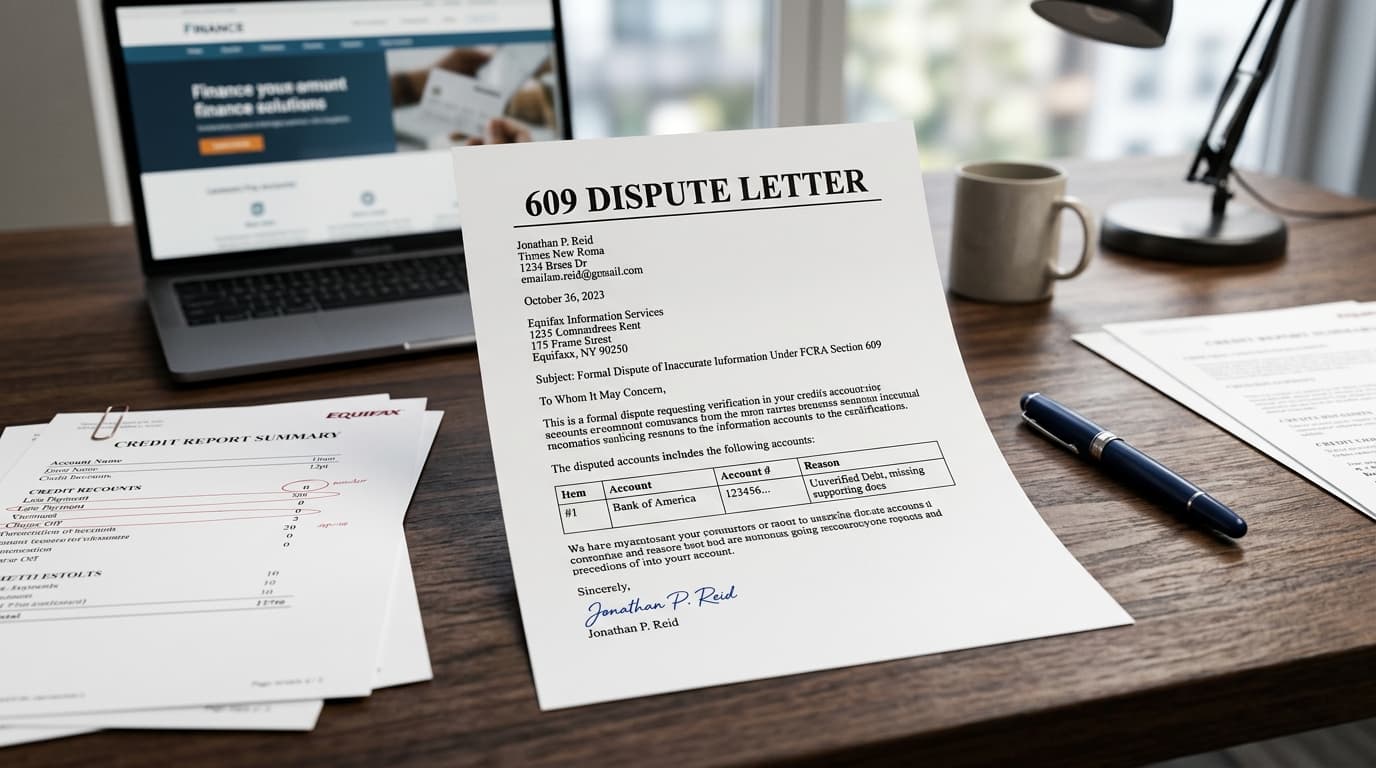
Your 609 Letter (Practical Template)
Customize this for each bureau and each account. Avoid copy-paste spam; specifics win.
Full Name
Current Address
City, State ZIP
SSN (last 4) | DOB | Phone: 336-310-0090

Date

[Equifax/Experian/TransUnion]
Address

Subject: Section 609 Request for File Information and Supporting Records

I am requesting, under FCRA §609(a), the source information and records you relied on to report the following items on my credit file. Please provide copies of:

• Application or agreement bearing my signature (if applicable)
• Itemized billing statements, payment history, and charge-off details
• Assignment/chain-of-title documents for any collection(s)
• Method of verification, relevant e-OSCAR codes, and ACDV responses
• Any dispute codes or Metro 2 fields furnished for these items

Items (attach report pages with highlights):
1) Furnisher: ______ | Account: ****____ | Opened: ____ | Balance: ____ | Status: ____
2) Furnisher: ______ | Account: ****____ | Opened: ____ | Balance: ____ | Status: ____

Enclosed are copies of my government ID and proof of address. Please respond to the address above.

Sincerely,
[Signature]
How to Turn a Thin 609 Response into a Solid 611 Deletion Attempt
Suppose TransUnion sends only a one-page summary with no signed agreement and the collector can’t produce a complete chain of assignment. In your 611 reinvestigation, you’d point to the missing documents and any cross-bureau inconsistencies (e.g., Equifax shows a different open date). Ask for a deletion or correction because the furnisher cannot currently verify the disputed fields.
Realistic Timelines (and How Pros Save Months)
Most consumers who fail with disputes either wait too long between steps or send generic templates that don’t cite facts. A tight cadence wins:
- Week 0: Send 609 requests to all three bureaus.
- Week 4–6: Review responses. Prepare 611 disputes citing documentation gaps or factual inconsistencies.
- Week 6–10: Follow up with direct-furnisher disputes. Add supporting exhibits (bank statements, payoff letters, police reports for ID theft, etc.).
- Week 10–14: Advanced reinvestigation if needed. Consider CFPB complaint when a furnisher ignores Reg V duties.
Crowned Credit runs this as a managed, staged process so you’re not starting from scratch each time. Our teams handle the paperwork, track deadlines, and escalate strategically.
What About “609 Letter Kits” and One-Size Templates?
They’re popular because they’re cheap and fast. They also get ignored. Bureaus and furnishers spot boilerplate a mile away. You’ll get better traction when your letters reference specific report fields, dates, balances, and the exact documents they failed to produce in response to your 609 request.
609 Letters vs. Other Proven Tactics
- Goodwill letters work for late payments with otherwise strong history. See our guide: How to Write a Goodwill Letter (2026).
- Pay-for-delete can settle paid collections when the collector agrees in writing. Read: Pay for Delete Letter (2026).
- Hard inquiry challenges matter if you didn’t authorize them. Start here: Remove Hard Inquiries (2026).
- General disputes when multiple fields are wrong: Dispute Errors (2026 Step-by-Step).
Frequently Asked Questions
Does a 609 letter improve my credit score? Not directly. It’s an information request. If the follow-on 611 dispute leads to a correction or deletion, that can impact your score.
Do I send 609 requests to all three bureaus? Yes, if the item appears on all three. Each bureau maintains its own file and must respond independently.
Should I include my Social Security Number? Include only the last four digits for identification, plus your DOB and current address.
What if the bureau replies with “verified” but provides no documents? That’s your signal to cite the failure to substantiate and escalate with a 611 reinvestigation and, if needed, a CFPB complaint with exhibits.
Can I use authorized user tradelines to rebuild? Yes — when used correctly, AU tradelines can help establish history while you build primary accounts. We include AU strategy in certain plans when it fits the profile.
When It Makes Sense to Hire a Pro
If you have multiple collections, charge-offs, or a mixed file across bureaus, the “do everything yourself” path can stretch to many months. Crowned Credit runs a proven protocol that blends 609 requests with 611 disputes, direct-furnisher challenges, and when needed, regulatory escalation. We keep it compliant, targeted, and on schedule.
Plans & Pricing
- Essential: $150 enrollment + $99/mo
- Accelerated: $249 enrollment + $199/mo
- Momentum: custom quote, one-time
Questions? Call us at 336-310-0090, or get scheduled now.
Book your free consultation → or review pricing & plan details.
CROA & Compliance Note
We don’t make promises of specific score increases or timelines. Results vary based on your credit profile, furnisher responses, and documentation quality. Under the FCRA, bureaus and furnishers must report data that is accurate and verifiable; properly executed disputes seek corrections or deletions when verification fails.
Helpful Next Reads
- How to Read Your Credit Report (2026 Guide)
- How to Remove Collections from Your Credit Report (2026)
- Credit Utilization: The #1 Factor Killing Your Credit Score
- What Credit Score to Buy a House (2026)
Bottom Line
A 609 letter is a spotlight, not a sledgehammer. Use it to make the bureaus and furnishers show their work. When the paperwork is thin or the data conflicts, that’s your opening to press a 611 reinvestigation. Done right, this combo can clean up a surprising amount of baggage without guesswork — and without wasting cycles on empty templates.