FICO Score vs. VantageScore: What's the Difference and Which One Actually Matters?

Ashley Rivera
Credit Repair Specialist
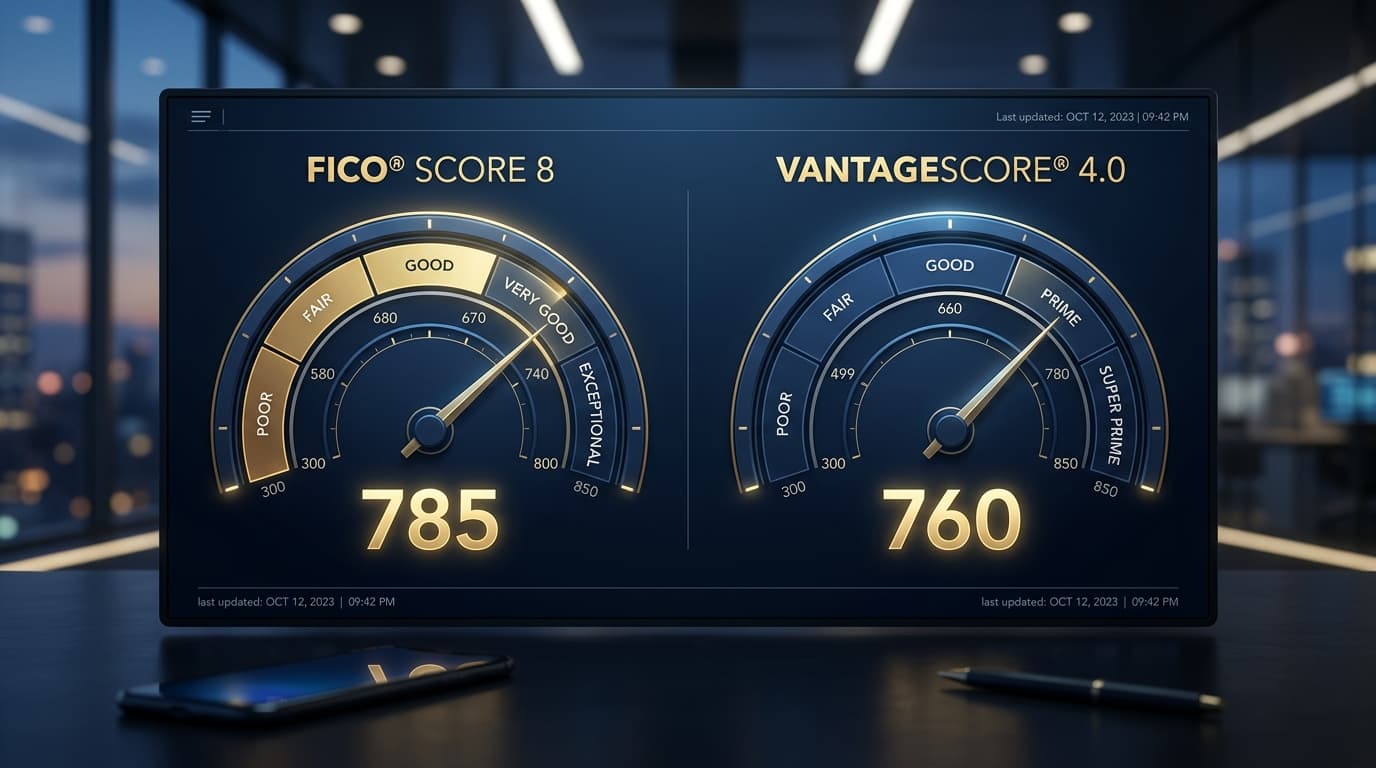
You check your credit score on Credit Karma: 712. Feels pretty good. Then you walk into a car dealership, and the finance manager tells you your score is 668. Suddenly you're looking at a higher interest rate — or a flat-out denial.
What happened? You didn't miss a payment. You didn't open a new card. The difference is simpler than you think: Credit Karma showed you a VantageScore. The dealership pulled your FICO score. And those two numbers don't always agree.
If you've ever been confused by the gap between the score you see online and the score a lender uses, this guide will clear it up. We'll break down exactly how each model works, where they diverge, and — most importantly — which one you should actually be tracking if you're trying to qualify for a mortgage, car loan, or credit card.
Two Scoring Models, One Credit Report
Both FICO and VantageScore analyze the same underlying data: your credit reports from Equifax, Experian, and TransUnion. They both produce a number between 300 and 850. They both try to predict the same thing — how likely you are to fall 90+ days behind on a payment in the next 24 months.
But the way they weigh your data is different. Think of it like two coaches watching the same football game film: they're looking at the same plays, but one might care more about passing yards while the other focuses on third-down conversions.
Here's a quick breakdown of who's behind each model:
- FICO — Developed by Fair Isaac Corporation in 1989. Independent company. Used by approximately 90% of top U.S. lenders for actual lending decisions.
- VantageScore — Created in 2006 as a joint venture by Equifax, Experian, and TransUnion. Commonly provided through free credit monitoring apps like Credit Karma, Chase Credit Journey, and Capital One CreditWise.
How FICO Calculates Your Score
FICO has been the standard for nearly four decades. The current widely-used version (FICO 8) breaks down like this:
- Payment history — 35%: Have you paid on time? Late payments, collections, charge-offs, and bankruptcies hit this category hardest. A single 30-day late payment can drop your FICO score 60-110 points depending on where you started.
- Credit utilization — 30%: How much of your available credit are you actually using? If you have a $10,000 credit limit and a $3,000 balance, that's 30% utilization. FICO penalizes you heavily once you cross the 30% mark, and the damage accelerates past 50%.
- Length of credit history — 15%: The age of your oldest account, newest account, and the average age across all accounts. Closing your oldest credit card can tank this category overnight.
- Credit mix — 10%: FICO likes seeing a combination of revolving credit (credit cards) and installment loans (auto loans, mortgages, personal loans). Someone with only credit cards might score lower than someone with cards plus an auto loan.
- New credit — 10%: How many hard inquiries have you had recently? Each one typically dings your score 5-10 points, though the impact fades after about 12 months.
How VantageScore Calculates Your Score
VantageScore 4.0 (the latest version) uses six categories instead of five, and the weightings are noticeably different:
- Payment history — 41%: Even heavier emphasis on payment behavior than FICO. VantageScore 4.0 also uses "trended data" — meaning it looks at whether your balances have been going up or down over time, not just where they sit today.
- Depth of credit — 20%: Similar to FICO's "length of history" but weighted more heavily. Includes the age of your accounts and the types of credit you carry.
- Credit utilization — 20%: Same concept as FICO but weighted 10 points lower. Still matters, but VantageScore is slightly more forgiving here.
- Balances — 11%: Total amount owed across all accounts. This is separate from utilization — even if your utilization is low, carrying high absolute balances can still ding you.
- Recent credit — 5%: New accounts and inquiries. VantageScore is generally more lenient on inquiry shopping — it deduplicates inquiries across a 14-day window regardless of loan type.
- Available credit — 3%: How much total credit you have access to. Higher available credit generally helps.
The Practical Differences That Actually Affect You
The category weightings are interesting, but here's what matters in the real world:
1. Minimum History Requirements
FICO requires at least one account that's been open for six months and at least one account that's reported activity in the last six months. If you're brand new to credit, you won't have a FICO score at all — you'll be a "credit invisible."
VantageScore can generate a score with just one account and one month of history. This is why someone who just got their first secured credit card might see a VantageScore on Credit Karma but get told they have "no score" when applying for a loan that uses FICO.
2. How They Handle Late Payments
Both models punish late payments, but they handle paid collections differently. VantageScore 4.0 ignores paid collection accounts entirely — once you pay off a collection, it stops hurting your VantageScore. FICO 8 still counts paid collections against you (though the newer FICO 9 and FICO 10 models have started ignoring them too).
This is a big deal. If you settled a $500 medical collection last year, your VantageScore might have already recovered while your FICO 8 is still dragging.
3. How They Handle Medical Debt
VantageScore 4.0 excludes medical collections entirely from scoring — regardless of whether they've been paid. FICO 8 still counts unpaid medical collections after a 180-day grace period, though FICO has reduced the impact compared to older versions.
Combined with the recent changes to medical debt reporting, this is an area where the two scores can diverge significantly.
4. Inquiry Shopping Windows
When you're shopping for a mortgage or auto loan, multiple lenders will pull your credit within a short window. Both models recognize this and deduplicate — but the windows differ.
FICO gives you a 45-day window for mortgage and auto inquiries (they all count as one). VantageScore uses a 14-day rolling window but applies it to all inquiry types, not just mortgages and auto loans. So if you apply for two credit cards within 14 days, VantageScore might count that as one inquiry while FICO would count both.
5. Authorized User Accounts
Both models include authorized user tradelines in their scoring, but VantageScore has historically given them slightly less weight. FICO tends to give authorized user accounts full scoring impact — which means being added to a parent's or spouse's old, low-balance card can boost your FICO more than your VantageScore.
This is one reason building credit from scratch often involves an authorized user strategy — the FICO impact is substantial.
What's Changing in 2026: FICO 10T and VantageScore 4.0
The mortgage industry is going through its biggest scoring shake-up in decades. In October 2022, the Federal Housing Finance Agency (FHFA) approved both FICO 10T and VantageScore 4.0 for use by Fannie Mae and Freddie Mac. As of early 2026, the transition is actively underway.
Here's what this means:
- Trended data is now standard. Both FICO 10T and VantageScore 4.0 use trended data — they look at your balance trajectory over 24 months, not just a snapshot. If you've been steadily paying down a $15,000 credit card balance, that momentum will now help your score. If your balances have been creeping up, it'll hurt.
- Bi-merge replaces tri-merge. Mortgage lenders used to pull all three bureau reports and use the middle score. Under the new system, they'll pull two bureaus and use the lower of the two scores. This means every bureau's report matters even more.
- More than 40 lenders have already joined the FICO 10T Adopter Program for non-conforming mortgages as of February 2026. The conforming mortgage transition (Fannie/Freddie) is expected to be complete by late 2026.
The bottom line: if you're planning to buy a house, the scoring model your lender uses is actively changing right now. Cleaning up your credit reports across all three bureaus is more critical than ever.
Which Score Do Different Lenders Actually Use?
This is the question that matters most. Here's the reality by loan type:
- Mortgages: Historically FICO 2 (Experian), FICO 4 (TransUnion), and FICO 5 (Equifax). Transitioning to FICO 10T and VantageScore 4.0 throughout 2026.
- Auto loans: Most dealers use FICO Auto Score 8 or FICO Auto Score 9 — industry-specific versions that weigh your auto payment history more heavily.
- Credit cards: Typically FICO Bankcard Score 8 or standard FICO 8. Some issuers use FICO 9.
- Personal loans: Usually FICO 8 or FICO 9. Some online lenders use VantageScore.
- Landlords/apartments: A mix — some use FICO, others use VantageScore, and some use tenant-specific screening reports from services like TransUnion SmartMove or Experian RentBureau. Check our guide on credit scores for renting for the full breakdown.
The pattern is clear: for the biggest financial decisions in your life — mortgages and auto loans — lenders overwhelmingly use FICO. VantageScore is growing, especially in personal lending, but FICO still dominates roughly 90% of lending decisions.
Why Your Scores Can Be 50+ Points Apart
Now you understand the mechanics, but here's a common scenario that trips people up:
Say you have a paid medical collection from 2024, a 3-year-old credit card with 25% utilization, and an authorized user account on your mom's 15-year-old Discover card.
Your VantageScore might be 710 because it ignores the paid medical collection, gives moderate credit for the authorized user account, and weighs your payment history heavily (which is clean).
Your FICO 8 might be 658 because it still counts that paid medical collection, gives the authorized user account more weight (which helps), but the collection drag outweighs the benefit.
That 52-point gap is the difference between a 6.5% and 7.2% mortgage rate — or roughly $45,000 in extra interest on a $300,000 home over 30 years.
Which Score Should You Track?
Here's the honest answer: track both, but prioritize FICO.
Free VantageScore sources (Credit Karma, Credit Sesame) are useful for monitoring trends and catching errors. If your VantageScore drops 40 points suddenly, something changed on your report and you need to investigate.
But when you're preparing for a specific financial move — buying a car, applying for a mortgage, getting a business loan — you need your actual FICO score. Here's where to get it:
- Experian.com: Free FICO 8 from Experian
- Discover Scorecard: Free FICO 8 from TransUnion (you don't need a Discover card)
- myFICO.com: Paid service that shows all FICO versions across all three bureaus — the gold standard if you're 3-6 months from a major application
- Your bank or credit card: Many issuers now provide free FICO scores on statements or in their app
How to Improve Both Scores at the Same Time
Good news: the fundamentals work for both models. If you focus on these five things, your FICO and VantageScore will both trend upward:
1. Dispute inaccurate, unverifiable, and outdated items. Under the Fair Credit Reporting Act (FCRA), creditors and the bureaus are legally required to verify everything on your report. If they can't verify it, they must remove it. This applies to late payments, collections, charge-offs, and even accounts you recognize. A strategic dispute process can clean up both reports simultaneously. If you're unsure where to start, talk to a credit specialist who can pull all three reports and identify every disputable item.
2. Pay down revolving balances aggressively. Credit utilization is 30% of your FICO and 20% of your VantageScore. Get individual card utilization below 30%, and ideally below 10% for maximum impact. If you can't pay down the full balance, request credit limit increases to reduce the ratio.
3. Don't close old accounts. That store card you opened eight years ago but never use? Keep it open with a zero balance. It's helping your average age of accounts (which both models value) and keeping your total available credit high.
4. Set up autopay for every single account. One 30-day late payment can erase months of progress. Payment history is the #1 factor in both models (35% for FICO, 41% for VantageScore). Even a $25 minimum payment on autopay prevents the worst-case scenario.
5. Check all three bureau reports regularly. Your Equifax report might show a collection that doesn't appear on your TransUnion report. With the mortgage industry moving to a bi-merge model in 2026, a negative item on even one bureau can sink your application. Pull your free reports at AnnualCreditReport.com — you're entitled to free weekly reports from all three bureaus.
When Professional Help Makes the Difference
Monitoring your scores and making on-time payments is straightforward. But what happens when your reports are cluttered with inaccurate collections, old charge-offs that should have fallen off, or late payments that were reported incorrectly?
That's where the dispute process gets complex — and where most people either give up or send generic dispute letters that get rubber-stamped and denied.
At Crowned Credit, we pull all three bureau reports, identify every item that can be challenged under the FCRA, and run a strategic dispute process tailored to your specific situation. We don't send the same cookie-cutter letter for every client — because a charge-off from Capital One requires a different approach than a medical collection from a local provider.
Our plans start at $150 enrollment + $99/month (Essential) for clients with a few targeted items, or $249 enrollment + $199/month (Accelerated) for reports that need aggressive, multi-bureau work. For clients who want everything handled upfront, our Momentum plan is a one-time, prepaid investment priced by custom quote.
Want to see what's actually on your report and get a clear action plan? Book a free consultation or call us at 336-310-0090.
Disclaimer: Credit repair is not guaranteed. Results vary based on individual credit profiles, the accuracy of reported information, and creditor/bureau responses. Crowned Credit operates in compliance with the Credit Repair Organizations Act (CROA). We cannot promise specific score increases or timelines. Past results do not guarantee future outcomes.